From the source
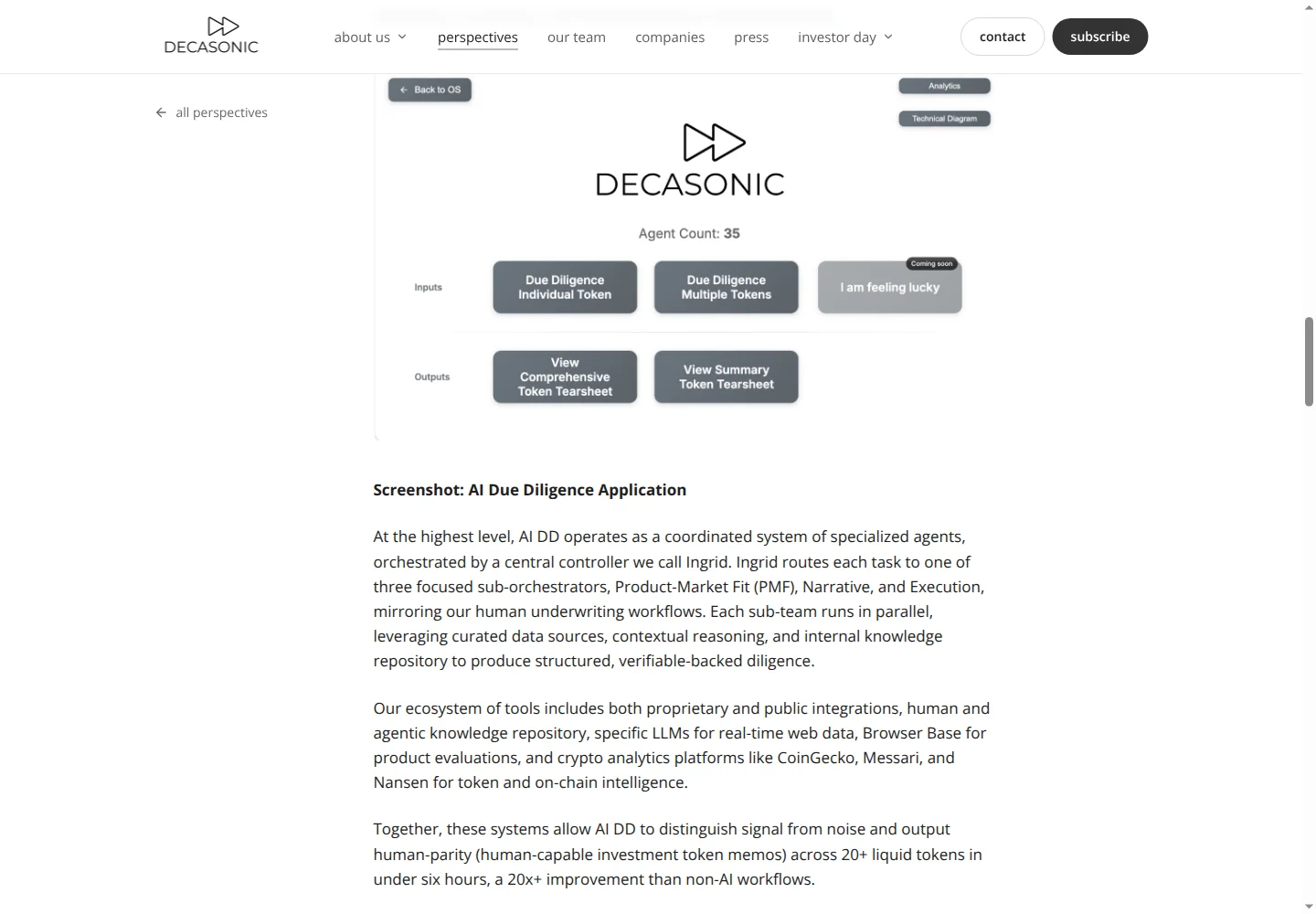
How it works
- Abdul Al Ali reports more than 20 liquid-token memos in under six hours and a greater-than-20-fold improvement over non-AI work. Exact manual baseline, repeated-run count, measurement dates and reviewer-time accounting are absent.
- Human-parity quality is the firm’s characterization, not an external evaluation. Throughput is not an investment-return result.
- The public account describes three coordinated research workstreams and source cross-checks. Private AI-OS, model configuration, datasets and memo-generation code are not supplied.
Results
Decasonic investor Abdul Al Ali reports memos covering more than 20 liquid tokens in under six hours. He claims a greater-than-20-fold improvement over non-AI workflows. The article gives no exact manual baseline, repeated-run count, measurement dates or accounting for reviewer time. “Human-parity” quality is the firm's characterization, not an external evaluation or an investment-return result.
Workflow guide
Define the token list and underwriting questions for product-market fit, narrative and execution.
Prepare a read-only analogue of the coordinator pattern. Obtain approved protocol metrics, developer activity, product observations and market communications with source references.
Review evidence through the three specialist workstreams. Cross-check important claims against independent data points.
Draft a memo for each token. Separate observed facts, conflicting evidence and investment-team judgments.
Have qualified investors verify the memos and decide investment actions. Do not let the research system trade or move funds.
Compare the fixed token batch with the manual baseline. Record elapsed time, investor review, source coverage, corrected errors and tool cost per accepted memo.