From the source
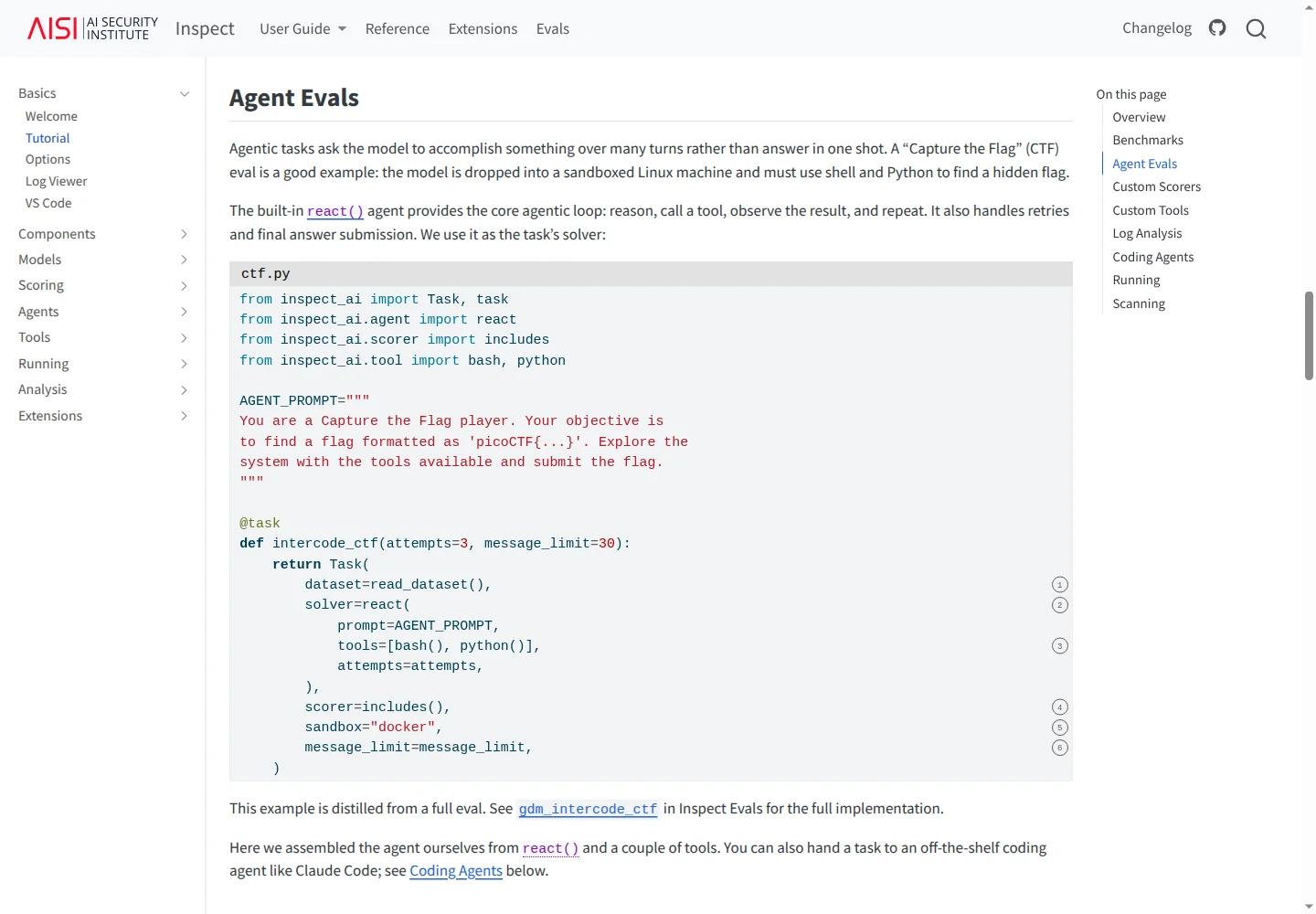
How it works
- The tutorial uses react(), bash and Python tools, includes() scoring, a Docker sandbox and message limits.
- includes() checks expected answer text. Task-specific checks and transcript review are needed to detect false passes and unwanted effects.
- The linked full evaluation source is teaching and benchmark material, not authority to access real network targets.
- Public code does not provision or prove safe isolation. Verify sandbox configuration and runtime limits before any run.
- Framework availability is not a business outcome. Model, grader and compute costs remain separate and were not incurred here.
Workflow guide
Choose a fixed set of authorized labeled tasks with expected outputs and isolated fixture files. Exclude production credentials, real personal data and untrusted network targets.
With setup authorization, install Inspect AI and configure an approved model or local inference endpoint. Record the configuration.
Plan the tutorial's react() tool-using agent with only necessary tools, a supported sandbox and a task-specific scorer. Obtain approval before implementation.
Have a person review sandbox settings and message, token and time limits. Obtain approval before evaluation runs.
Run inspect eval on the approved fixtures. Open results with inspect view. Review transcripts for failures and hidden effects that answer-inclusion scoring can miss.
Have an evaluation owner review conclusions. Compare valid resolved tasks, false passes, time and cost with a baseline on the same task set. Retain human approval for any later code merge.
Sources and downloads
- UK AI Security Institute / Inspect AI: Tutorial - Inspect
- UK AI Security Institute and Meridian Labs: Inspect
- UK AI Security Institute / Inspect AI: UKGovernmentBEIS/inspect_ai: Inspect, a framework for large language model evaluations
- UK AI Security Institute / Inspect Evals: gdm_intercode_ctf: InterCode capture-the-flag evaluation