From the source
How it works
- The study concerns experienced open-source maintainers using February–June 2025 tools, mostly Cursor Pro and Claude 3.5/3.7 Sonnet. METR warns that the historical result no longer represents current model impact.
- The public CSV has 246 issue rows and 16 developer IDs. Sixteen rows lack post-review implementation time. These are file-structure checks, not a recomputed outcome.
- The released regression fills missing post-review time with the relevant treatment-group mean, adds initial and post-review time, and regresses log total time on treatment and the no-AI time forecast.
- The README defines a positive reported estimate as longer time with AI. Developer-reported times and the $150-per-hour participation payment are not a local productivity or savings estimate.
Results
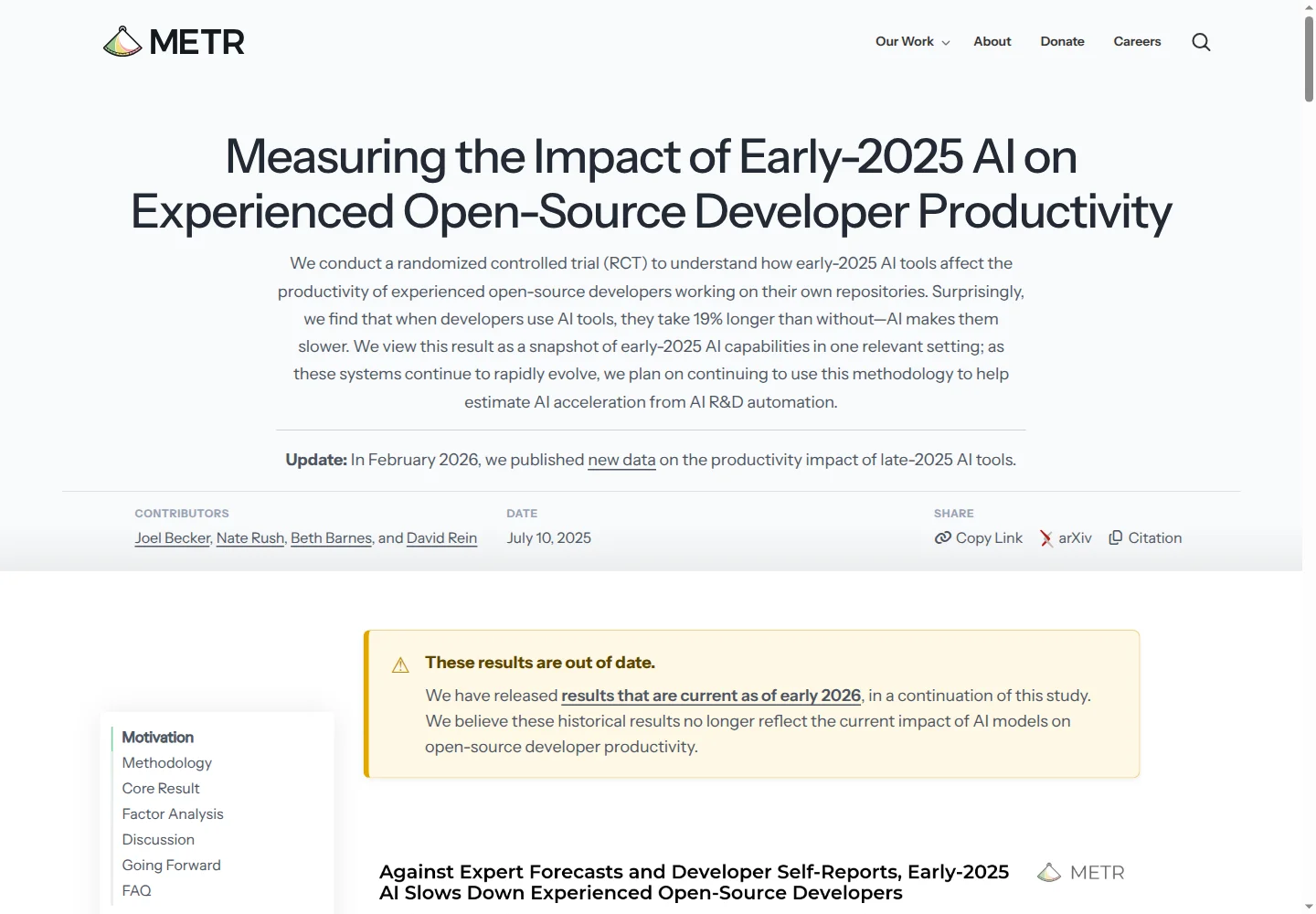
In METR's early-2025 randomized study, 16 developers completed 246 tasks. Allowing AI took 19% longer than disallowing it. The comparison used developer-reported implementation time for assigned real issues. Developers mostly used Cursor Pro and Claude 3.5/3.7 Sonnet when AI was allowed. The negative result concerns February–June 2025 tools and experienced open-source maintainers on the studied tasks. METR says these historical results no longer represent current model impact. The reusable value is the randomized evaluation design and data, not a claim that current tools improve or worsen productivity by this amount.
Workflow guide
Recruit consenting maintainers with real planned issues. Record task complexity and time forecasts before assignment.
Fix the task sample and write AI-use rules. Randomly assign tasks within the team to AI-allowed or no-AI conditions.
Record actual implementation time with stable tracking. Retain discarded and incomplete attempts in trial records.
Apply the same human review and quality criteria to both groups. Anonymize source, personal data and screen recordings before sharing.
Run the published regression on the supplied public dataset in an approved isolated environment. Use it to understand the method before analyzing your trial.
Have an evaluation owner check the analysis by task and reviewer. Report time ratios, review-adjusted completion time and accepted pull-request quality against the no-AI baseline.
Sources and downloads
- METR: Measuring the Impact of Early-2025 AI on Experienced Open-Source Developer Productivity
- METR: Measuring the Impact of Early-2025 AI on Experienced Open-Source Developer Productivity
- METR: METR/Measuring-Early-2025-AI-on-Exp-OSS-Devs
- METR: regression.py: METR core productivity regression
- METR: data_complete.csv: METR anonymized completed-issue data