From the source
How it works
- Natural-language criteria identify target roles, companies and relevant signals. Source pages support candidate facts and enrichment.
- The case describes a top-ten list when a seller opens the CRM. It does not supply the internal ranking algorithm or system prompt.
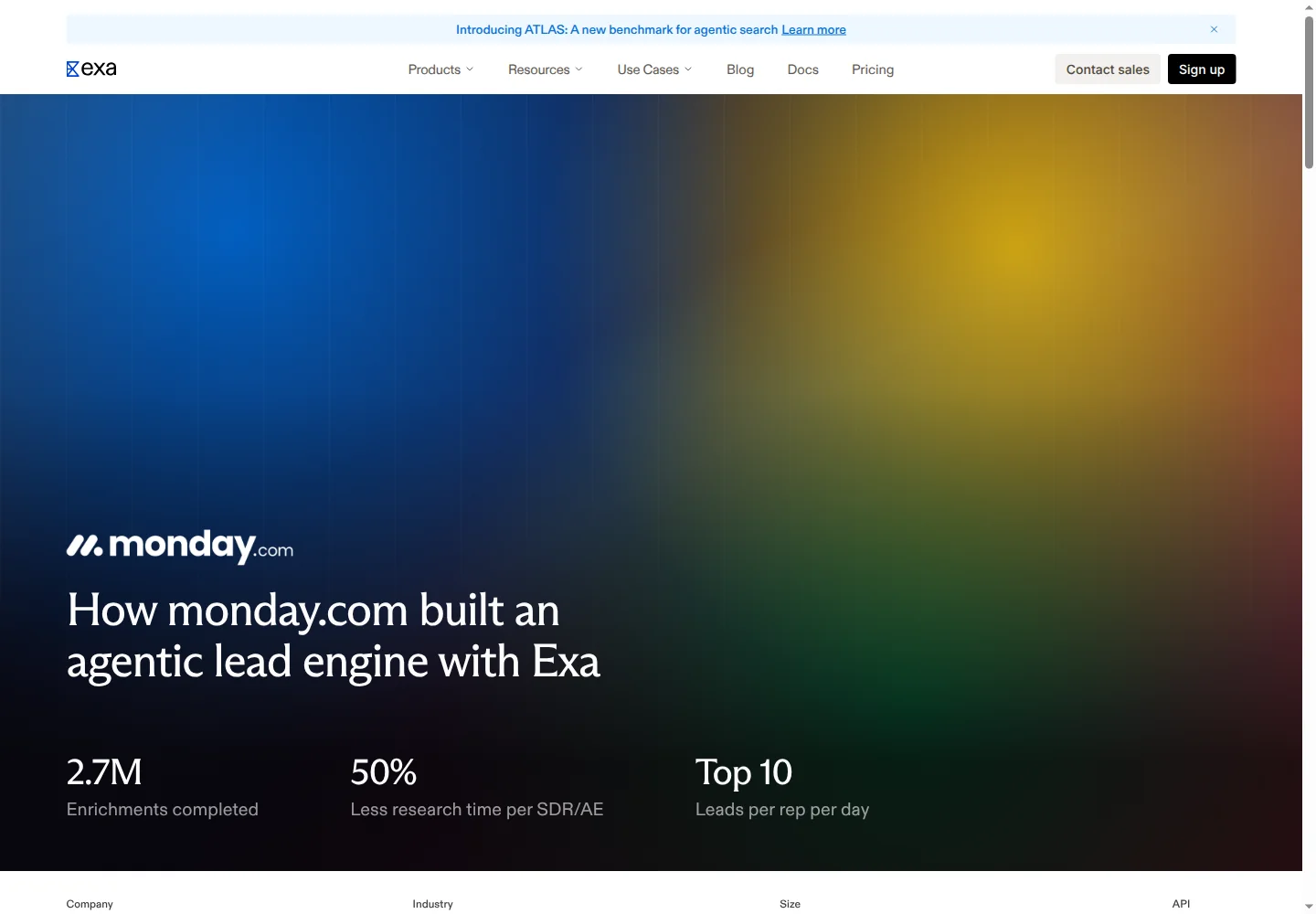
- Exa reports a 50% research-time reduction per sales development representative or account executive per prospecting cycle.
- Baseline hours, rep sample, cohort, evaluation method and observation window are not disclosed. The 2.7 million enrichment count is usage, not sales improvement.
- Public profiles may be stale or ambiguous. Verify current roles and identity rather than treating search output as guaranteed contact data.
Results
Exa reports a 50% reduction in research time per monday.com sales development representative or account executive per prospecting cycle. It describes a top-ten lead list generated from ideal customer profile criteria when a seller opens the CRM. The measuring team, baseline hours, number of reps, customer cohort, evaluation method and observation window are not disclosed. The separate count of 2.7 million enrichments measures product usage, not uplift.
Workflow guide
Define the target segment with geography, role, company stage and relevant recent changes.
Use authorized live company and people search to retrieve candidate records with evidence. Do not guess contact details.
Check criteria, source dates, current roles and identities before ranking candidates.
Prepare a sourced shortlist for seller review. Do not assume access to monday.com's internal ranking code or prompt.
Obtain approval before a separate CRM import or outreach action. Set an authorized refresh schedule.
Compare a fixed set of prospecting tasks with the previous process for research time, shortlist precision, current-role accuracy, accepted leads and cost per seller-approved contact.