From the source
How it works
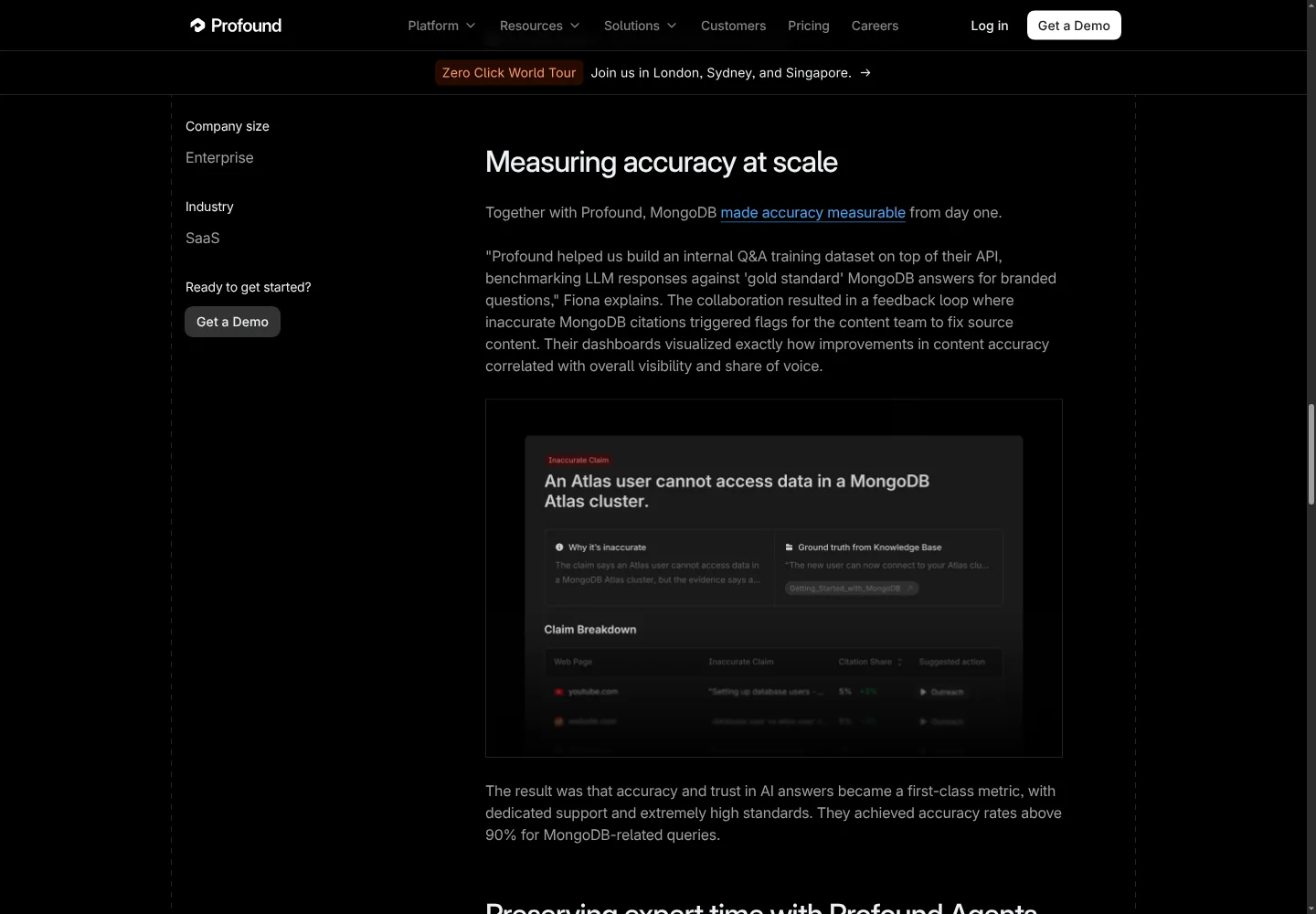
- The case describes a reference-answer dataset and citation feedback used to identify source-content corrections.
- Schema-markup suggestions require subject-matter review. The article does not provide a reusable customer agent export.
- Profound reports 50% higher AI-search visibility, over 90% answer accuracy and about 30% less release-update time.
- Sample sizes, baselines, scoring rubric and measurement window are absent. These reports are not independent causal estimates.
- Agent runs consume credits and enterprise packages vary. Public pricing does not establish MongoDB's contract or total evaluation cost.
Results
Profound's customer case reports 50% higher AI-search visibility, over 90% accuracy for MongoDB-related answers and about 30% less time to update releases with its schema agent. These are vendor/customer reports, not independent causal estimates. The page does not publish full prompts, a question sampling frame or the scoring rubric. Sample sizes, baselines and the measured time window are also absent.
Workflow guide
Build a versioned product-question set with expert-approved reference answers and source versions.
Collect dated answers through an authorized monitoring tool for a fixed engine set. Record baseline results.
Score correctness, missing information and stale citations against the references.
Assign source-document fixes and schema-markup drafts to documentation owners. Treat the case as a pattern, not a public copy of its internal agents.
Require product experts to approve changes before separately authorized publication.
Repeat the same questions and engine set after publication. Score accuracy, visibility, freshness, reviewer minutes and release-update time separately.