From the source
How it works
- The timing claims are vendor-reported production observations, not advertising lift or net cost savings. Asset counts, measurement window, staffing and timing boundaries are not disclosed.
- The expansion tutorial shows source-image upload and target dimensions. The example code was read, not run or validated as a production integration.
- The asynchronous guide describes job IDs, status and cancellation URLs, polling and retrieval after success. The initial response is not a finished image.
- No source image was uploaded, paid generation called or campaign asset reviewed. Designers and compliance reviewers must approve separately created variants before publication or spend.
Results
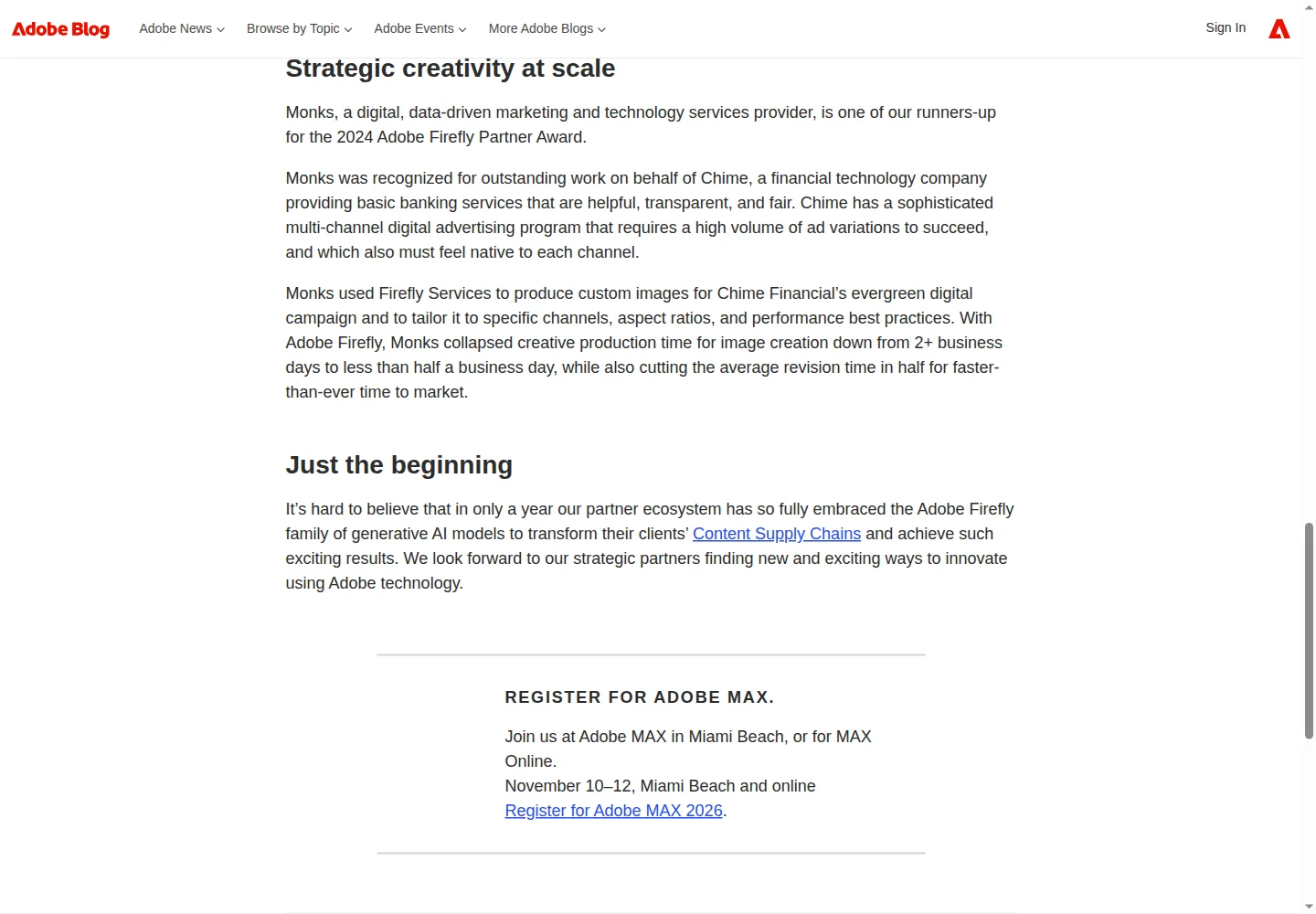
Adobe's 2024 partner-award report says Monks reduced image-creation production time for Chime's campaign from more than two business days to less than half a business day. It also reports that average revision time was cut in half. This is a vendor-reported production result, not evidence of advertising lift. Asset counts, measurement window, staffing and the exact timing boundary are not disclosed.
Workflow guide
Select rights-cleared, brand-approved source imagery. Record actual channel dimensions and campaign constraints.
Approve upload content and restrict Firefly credentials. Use the documented image-upload and expansion pattern for each size.
Follow Adobe's asynchronous job guidance to record job IDs, poll status and handle success or failure.
Retrieve completed assets. Have designers check visual fidelity, text, regulated claims, brand fit and native channel presentation.
Record approved-variant production time, revision time, rejected outputs, review effort and generation cost for the fixed comparable batch.
Require design and compliance approval before publication. Require separate human approval for advertising spend.