From the source
How it works
- The reported 8–12x engineer-time comparison concerns delegated migration tasks and prompting plus review hours. It is not an independently timed company-wide migration result.
- The more-than-20x task-cost estimate uses assumed engineer hourly costs. It is not audited spending or cash savings.
- The separate fourfold benchmark speed change is not the engineer-time ratio. Evaluation sample sizes are not disclosed.
- The expected 18-month migration plan is a projection, not an achieved completion-time improvement. Tests and engineer review remain necessary.
Results
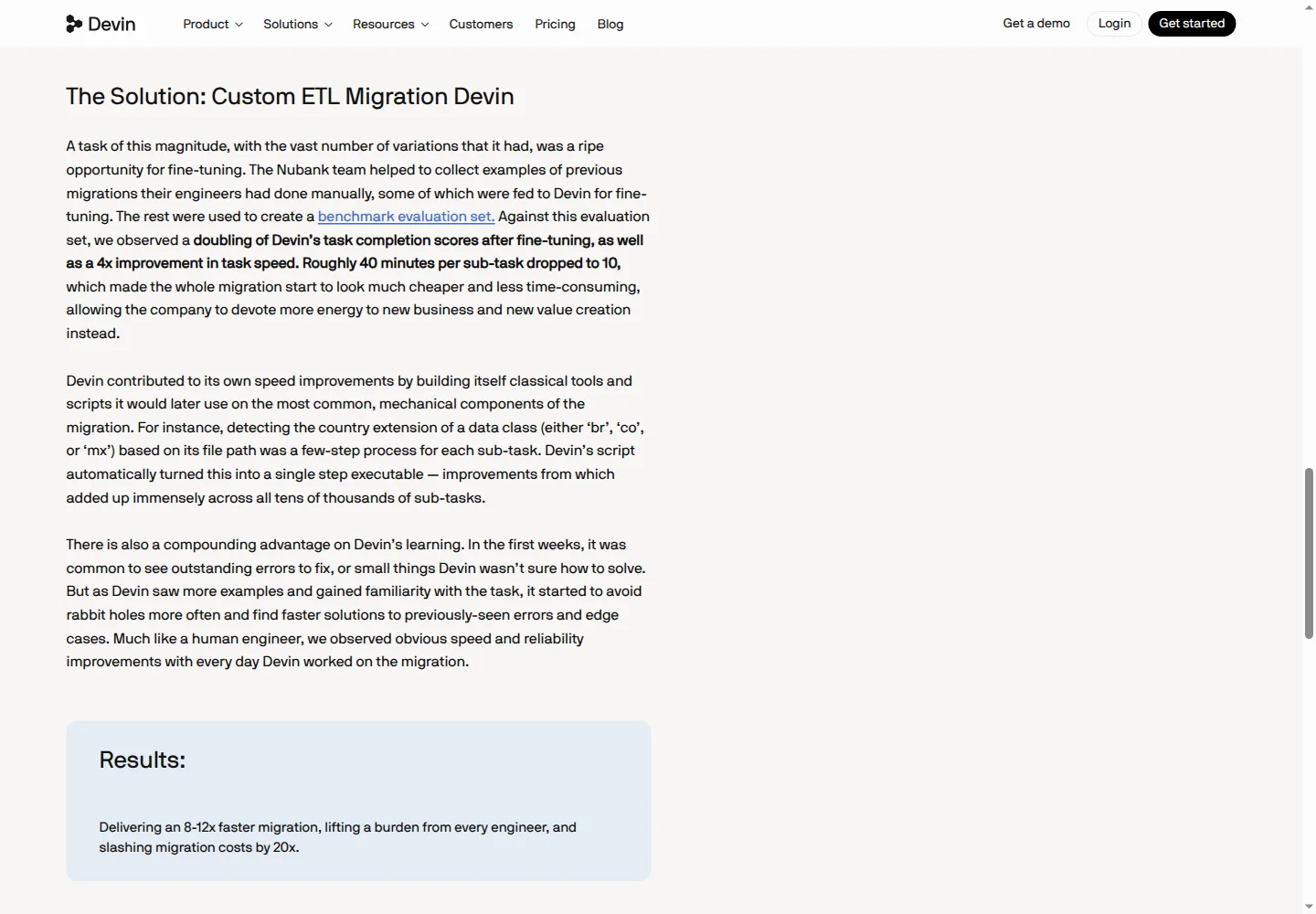
The customer and vendor case reports an 8–12x reduction in engineer time per delegated migration task. It compares typical manual engineering hours with prompting and review hours. The 8x headline and 12x narrative describe this range, not separate independent trials. The page also reports task-cost estimates more than 20x lower, using engineer hourly cost versus Devin running cost. This is not a verified company-wide cash saving. A reported fourfold benchmark speed change is separate from the engineer-time comparison. The projected 18-month migration plan is not a measured completion-time improvement.
Workflow guide
Inventory repeated ETL data-class changes with approved repository access. Select completed manual examples and a separate evaluation set.
Write migration rules from those examples. Identify routine decisions for a script, such as country extensions derived from paths.
Prepare a local pilot plan for a small, fixed batch. Obtain approval for code changes in an isolated environment.
Apply the rules to the approved batch. Compare test and benchmark results with the separate evaluation examples.
Have an engineer inspect each diff. Correct exceptions and run relevant checks before the engineer approves a production merge.
Record prompting hours, review hours, agent costs and regressions per accepted task. Compare with similar manual tasks.
Sources and downloads
Try Devin with Thomas’s referral link ↗ · We may receive a referral benefit.
Discuss this workflow →