From the source
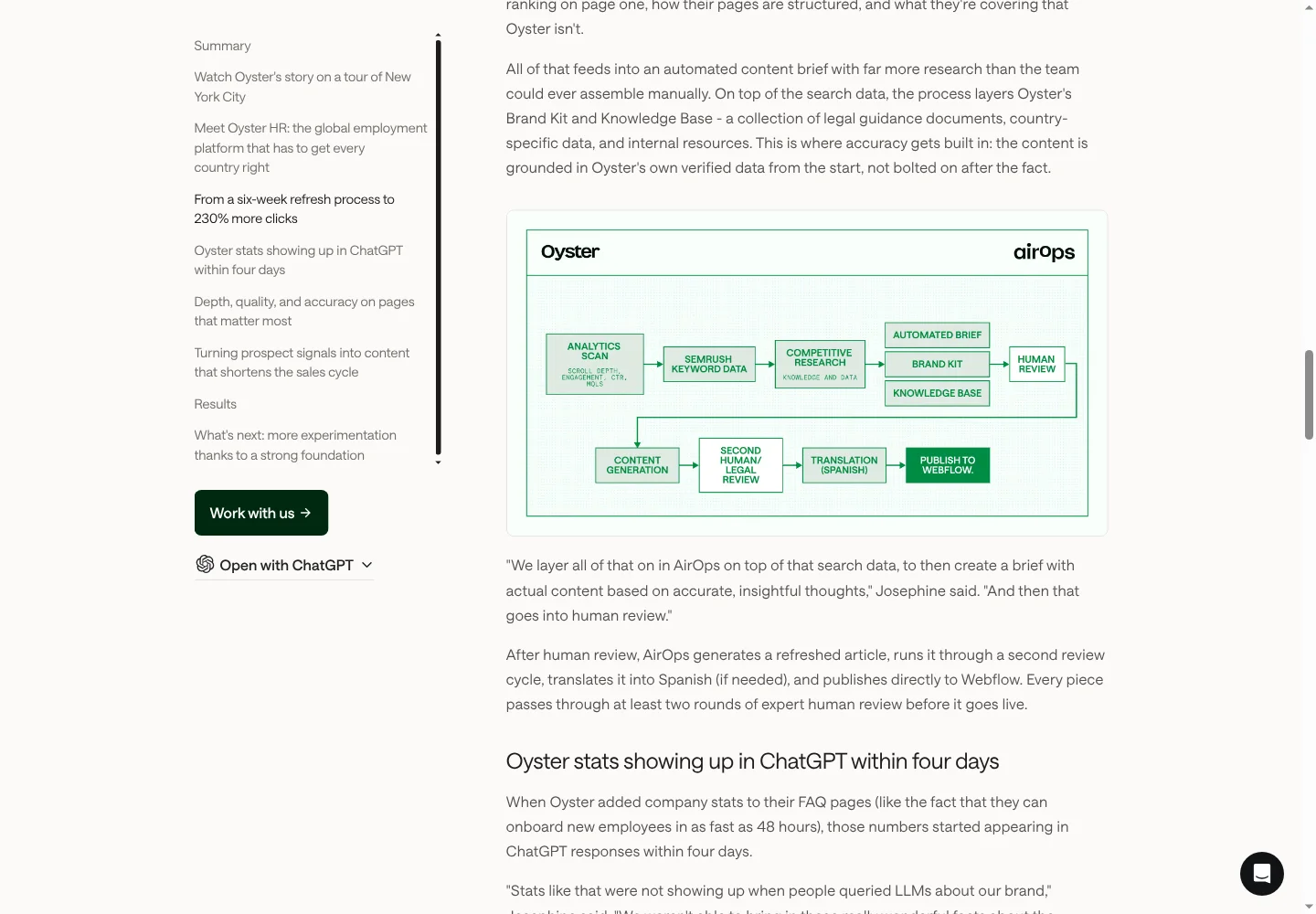
How it works
- Product questions and prospect confusion inform FAQ topics. Approved references support product and jurisdiction-specific claims.
- The reported pipeline includes review before release. Public architecture diagrams do not expose the underlying legal knowledge base or CMS access.
- AirOps reports more than 100 pages updated with FAQs in about 2.5 weeks, each passing human and legal review.
- It reports brand statistics cited in ChatGPT within four days of FAQ publication. That is a reported observation, not guaranteed indexing speed or causal proof.
- Prompt set, model version, repeated-sample rate and a controlled comparison are absent. Public plan limits do not establish Oyster's commercial or legal-review costs.
Results
AirOps reports more than 100 pages updated with FAQs in about 2.5 weeks, each passing human and legal review. It also reports brand statistics cited in ChatGPT within four days of FAQ publication. The citation is a reported observation, not reliable indexing speed or causal proof. The page gives no prompt set, model version, repeated-sample rate or controlled comparison.
Workflow guide
Select pages from approved product questions and prospect confusion. Do not expose prospect personal information.
Separate commercial FAQs from jurisdiction-specific employment-law claims.
Retrieve approved product facts and current authoritative country legal references. Record authority and update dates.
Draft concise FAQs in the brand voice. Cite factual and legal claims. Mark uncertainty for reviewers.
Require editorial and relevant legal approval before separately authorized CMS publication.
Compare the fixed page/question sample with the previous process. Check coverage, reviewer corrections, review time, source freshness, crawlability and repeated citation observations on a versioned query set.