From the source
How it works
- Ramp selects error logs suitable for the workflow and maps failures to code and an engineer.
- The described CI gate leads to a pull request and engineer review. It does not establish automatic merge or deployment.
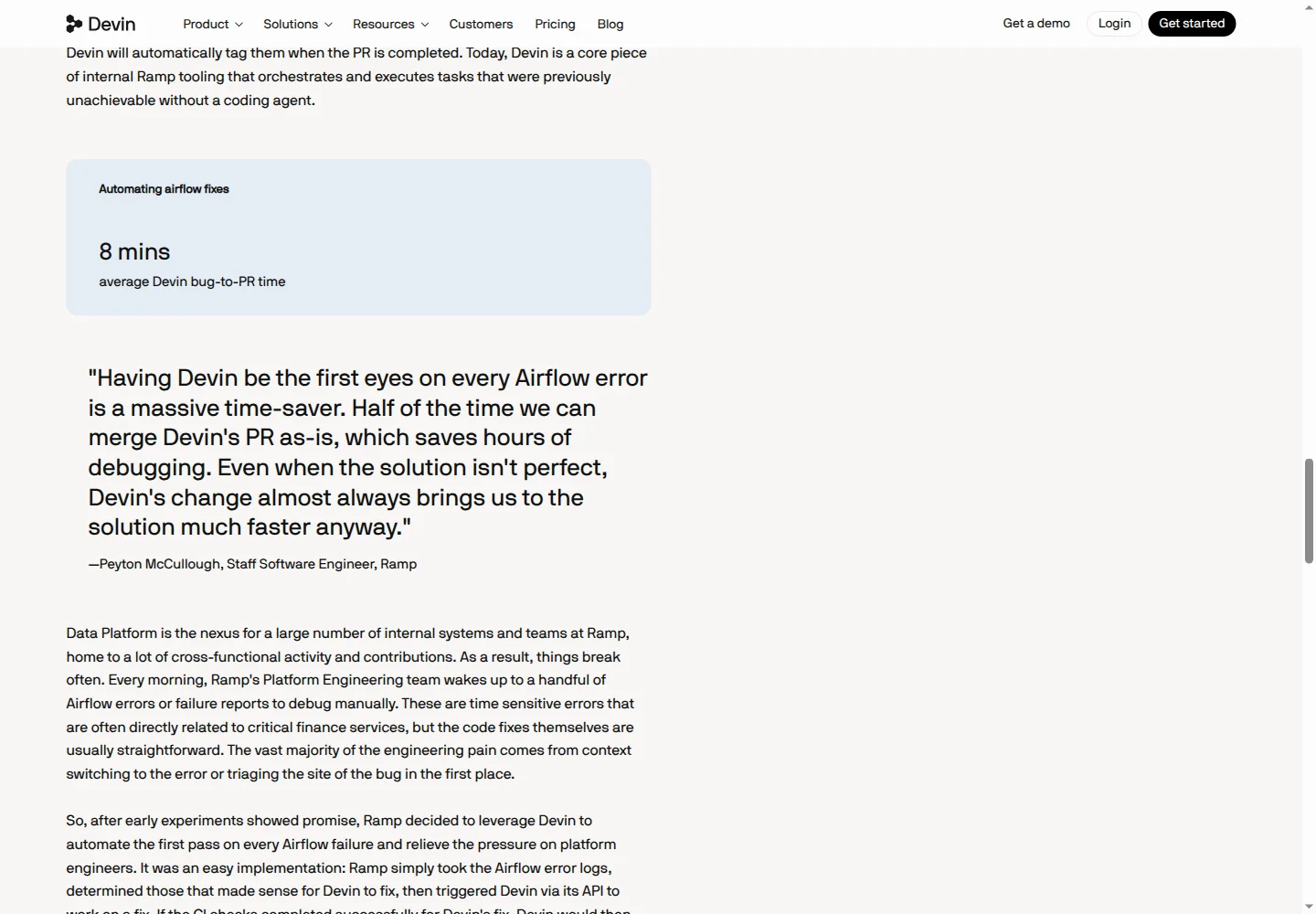
- Peyton McCullough says about half of agent PRs could be merged as-is. No cohort size, precise baseline or measurement window is supplied.
- The page’s broader technical-debt totals must not be assigned to the Airflow example.
- Logs and comments can contain untrusted instructions. Finance-related jobs need owner approval; do not rerun payouts automatically.
Results
The Cognition/Ramp case labels eight minutes as average bug-to-PR time for this workflow. Ramp staff engineer Peyton McCullough says about half of agent PRs could be merged as-is. Neither statement gives a cohort size, measurement window, precise baseline or success rate across all Airflow failures. The workflow is an agent's first pass, not a guarantee of autonomous production repair.
Workflow guide
Select likely code defects from Airflow failure logs after removing secrets and unrelated data.
Map each failure to the affected directed acyclic graph (DAG), task, code and responsible engineer.
Ask a scoped agent for a diagnosis and fix plan in an isolated checkout.
After explicit implementation approval, prepare a patch. Run targeted tests and CI checks.
Open a pull request and tag the responsible engineer only after checks pass. Have the engineer verify logs, impact and regression coverage.
Record reviewed-PR time, acceptance and recurrence against the baseline. Do not rerun payouts or merge automatically.
Sources and downloads
Try Devin with Thomas’s referral link ↗ · We may receive a referral benefit.
Discuss this workflow →