From the source
How it works
- The example worker prompt scopes a flag, file, branch and retained condition. It is not Ramp's complete coordinator playbook.
- Parallel workers handle separate changes. A cleanup agent combines outputs and checks conflicts before a consolidated pull request.
- Tests and downstream dependency checks still need an engineer to confirm intended runtime behavior.
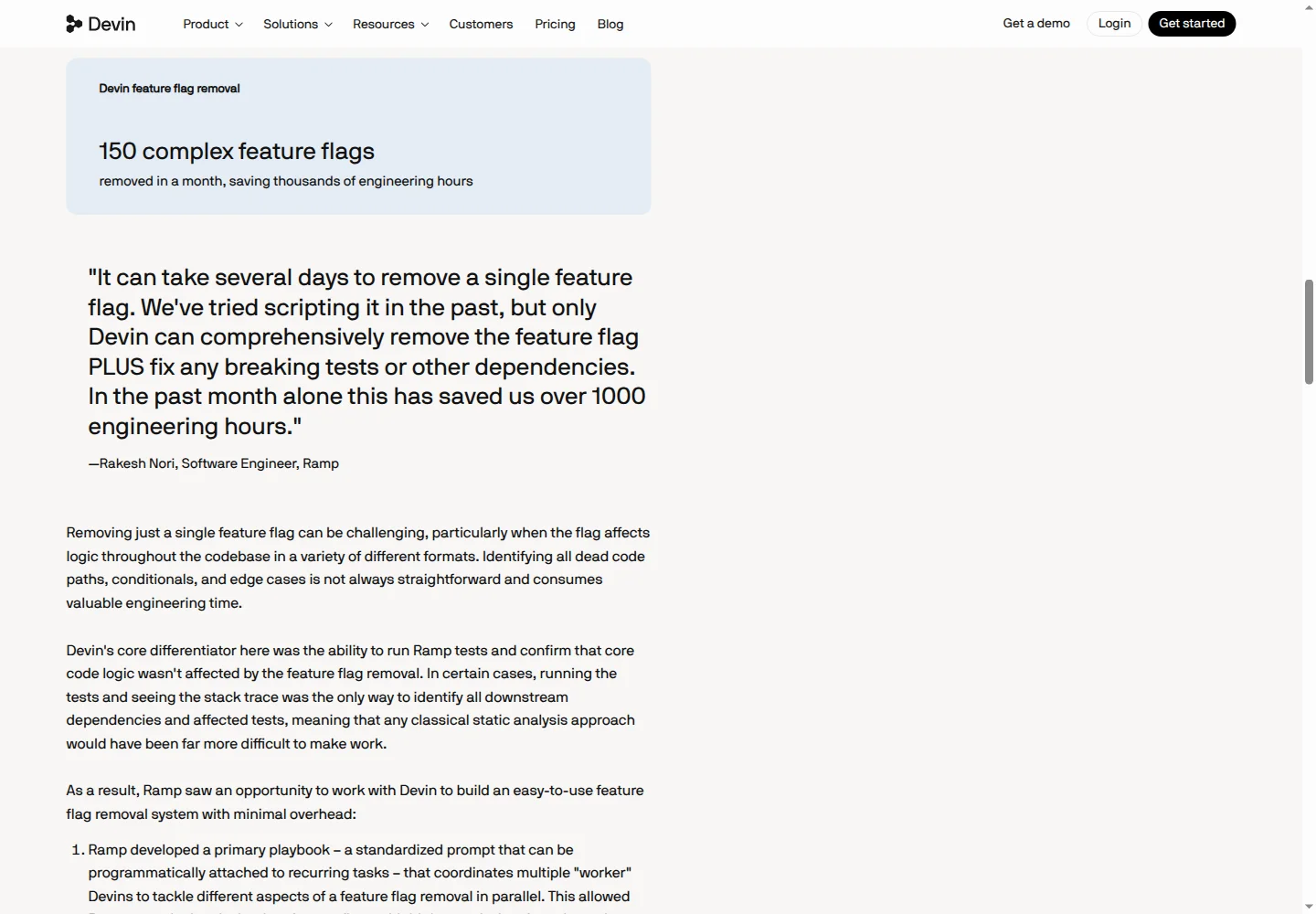
- The case reports 150 complex feature flags removed in a month. Rakesh Nori estimates more than 1,000 engineering hours saved in that month.
- Calendar dates, a matched manual baseline and the time-accounting method are not disclosed. Estimated hours are not measured cash savings or proof that all drafts passed unchanged.
Results
Cognition's case reports that Ramp removed 150 complex feature flags in a month. Ramp engineer Rakesh Nori estimates that this saved more than 1,000 engineering hours in that month. The case does not disclose calendar dates, a matched manual baseline or the time-accounting method. This is not measured cash saving. It does not show that every proposed removal passed review unchanged. The published worker prompt is an example, not Ramp's complete private coordination system.
Workflow guide
Select obsolete flags from an approved inventory. Confirm their final on or off states and rollout context with feature owners.
Map conditional paths, tests and downstream dependencies through approved access. Divide proposed edits into non-overlapping scopes.
Ask workers for plans using the published prompt pattern. Obtain explicit approval before code changes in isolated workspaces.
Use a cleanup agent to combine approved worker outputs. Run relevant tests on the combined patch.
Have an engineer verify intended runtime behavior and automated checks. Require approval of one consolidated pull request before merge.
Compare a fixed pilot sample with similar manual removals. Record safely removed flags per review hour, correction effort, regressions and post-merge incidents.
Sources and downloads
Try Devin with Thomas’s referral link ↗ · We may receive a referral benefit.
Discuss this workflow →