From the source
How it works
- The case describes a backlog of more than 100 slow tests, without publishing the original corpus or runtime distribution.
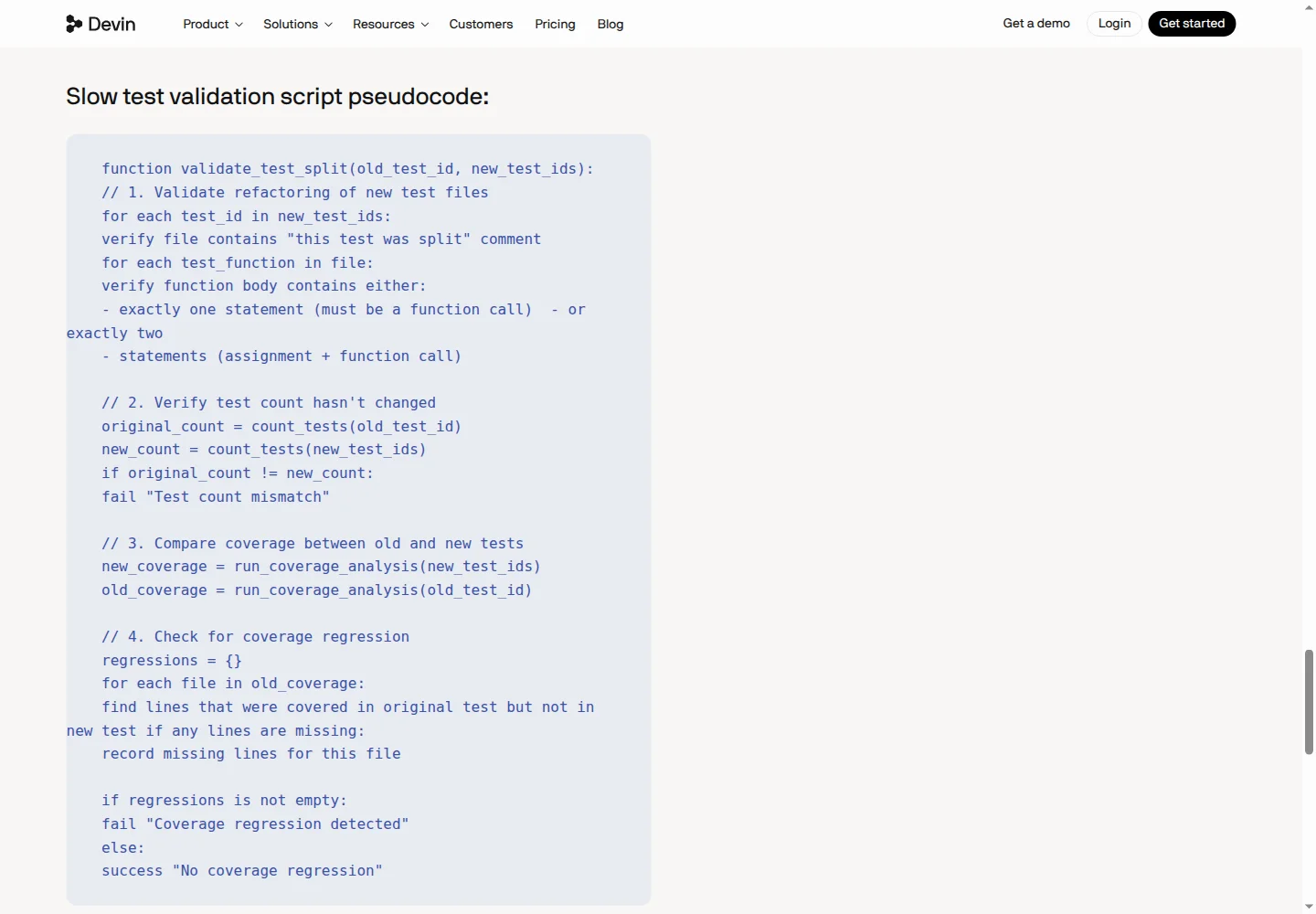
- The pseudocode compares test counts and covered lines before and after splitting. Lost covered lines are regressions.
- Matching counts and covered lines does not prove that intended assertions or side effects are equivalent. Engineers must review behavior separately.
- Maxim Enis reports a one-minute local suite reduction and estimates up to 20 minutes returned per engineer per day.
- Hardware, cache state, suite denominator and daily execution frequency are not disclosed. The daily estimate is not verified labor or cash savings.
Results
On Cognition's customer page, Ramp engineer Maxim Enis reports that local test-suite runtime fell by an entire minute. He estimates up to 20 minutes of development time returned per engineer per day. The story describes a backlog of more than 100 slow tests. It provides no timing dataset or daily-execution denominator. The daily figure is an estimate, not verified labor or cash savings. The validation pseudocode describes a pattern, not a ready-to-run validator or the original test corpus.
Workflow guide
Use approved repository access to list tests above the team's runtime threshold. Fix the pilot sample. Record original test counts, assertions, covered lines and timings.
Ask Devin for a plan to split files while preserving cases and assertions. Keep unrelated feature changes out of scope.
Obtain explicit approval for isolated code changes. Apply only the agreed split.
Use the published validation pattern to compare counts, covered lines and uncovered-line regressions. Have an engineer inspect intended assertions separately.
Repeat timings under matched hardware, cache, suite and CI conditions. Ask an engineer to review the patch and authorize the merge.
Report matched runtime, lost covered lines and review time separately. Do not infer daily savings without execution-frequency data.
Sources and downloads
Try Devin with Thomas’s referral link ↗ · We may receive a referral benefit.
Discuss this workflow →